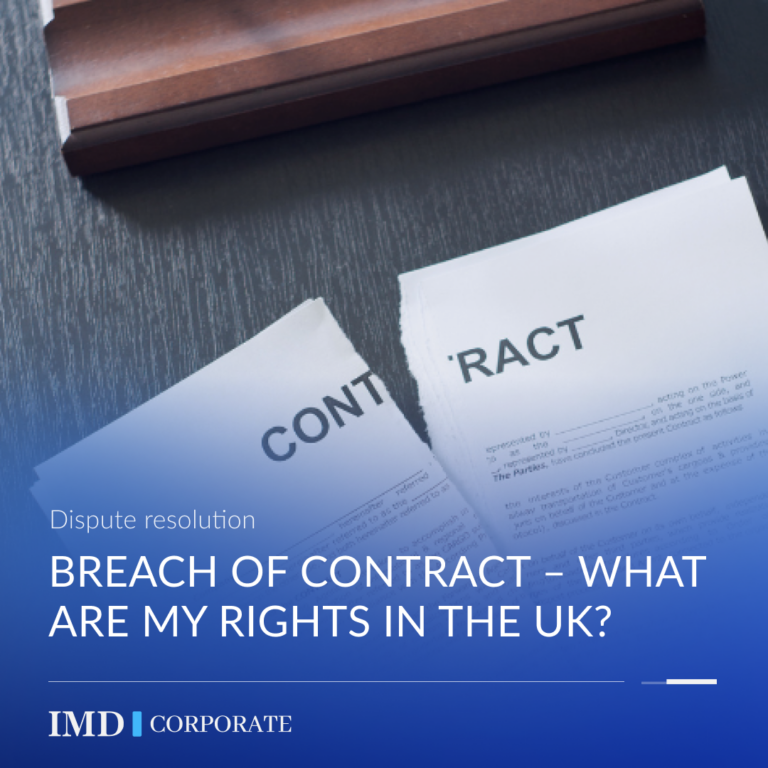

Contracts sit at the heart of every commercial relationship. When one party fails to meet its obligations, the consequences can be immediate and financially significant.
If you are dealing with a breach of contract, understanding your rights early is key to protecting your position and achieving a commercially effective outcome.
A breach of contract can disrupt operations, cash flow and commercial relationships. However, the law provides clear remedies, and with the right strategy, disputes can often be resolved efficiently.
Early advice and a structured approach will place you in the strongest position to protect your interests.
What is a breach of contract?
A breach occurs where a party fails to perform its obligations under a legally binding agreement.
This may include:
- failing to deliver goods or services as agreed;
- late or non-payment;
- delivering defective or non-compliant performance;
- refusing to perform altogether
Not every breach is equal. The seriousness of the breach will determine the remedies available and whether you are entitled to bring the contract to an end.
What are your legal rights?
Your rights will depend on the nature of the breach, but the core remedies are well established.
1. Damages
The primary remedy is financial compensation. The aim is to place you in the position you would have been in had the contract been properly performed. This may include loss of profit, wasted costs, or additional expenses.
2. Termination
Where the breach is sufficiently serious, you may be entitled to terminate the contract. This is a critical step and must be exercised carefully – wrongful termination can itself amount to a breach.
3. Court orders (injunctions or specific performance)
In certain cases, the court may require the defaulting party to comply with the contract or restrain particular actions. These remedies are less common but can be decisive.
4. Contractual protections
Many agreements include clauses dealing with breach, such as limitation of liability, indemnities, or interest provisions. These can significantly affect the scope of your claim.
What should you do if a contract is breached?
Your response should be measured and strategic.
As a starting point:
- review the contract carefully, including termination and dispute resolution clauses;
- gather evidence of the breach and resulting loss;
- avoid taking steps that could be interpreted as accepting the breach;
- seek legal advice before terminating or escalating the matter
In many cases, a structured pre-action approach can resolve disputes efficiently without formal proceedings.
For a broader overview of how these disputes are handled in practice, please see our dedicated page on IMD Corporate contractual disputes services.
Key risks to consider
Breach of contract claims are often straightforward in principle but complex in practice. Key risks include:
- difficulty proving loss or causation;
- limitation clauses restricting recovery;
- counterclaims alleging your own breach;
- premature termination exposing you to liability
Early legal input can help mitigate these risks.
How we can help
We advise businesses, directors and individuals on a wide range of contract disputes, from straightforward claims to complex, high-value litigation and arbitration.
Our approach is commercial and outcome-focused. We:
- assess your position and available remedies at an early stage;
- identify risks, including limitation clauses and potential counterclaims;
- prepare robust pre-action correspondence to maximise settlement prospects;
- act decisively in litigation or arbitration where required
We also have experience in cross-border disputes, acting for UK and international clients across sectors including technology, construction and commercial services.
Our focus is always on achieving a practical and cost-effective resolution aligned with your commercial objectives.
This article is for general information only and does not constitute legal or professional advice. Please note that the law may have changed since this article was published.