


Dispute resolution
 14 Apr 2026
 Is ADR faster than going to court?
When a commercial dispute arises, one of the first questions businesses ask is: how quickly can this be resolved? In many cases, the answer depends on the route you choose. Traditional litigation through the courts can be time-consuming, whereas Alternative Dispute Resolution (ADR) is often viewed as a faster, more efficient solution.
Read more 8 Apr 2026
 Who is liable when AI causes harm or makes a wrong decision?
As artificial intelligence becomes embedded in everyday business operations, from automated decision-making to predictive analytics, companies are increasingly asking a critical question: who is liable when AI causes harm or makes a wrong decision?
Read more 7 Apr 2026
 Can a shareholder force the sale of shares in a private company?
Disputes between shareholders are a common feature of private companies, particularly where relationships break down or the business reaches a deadlock. One of the most frequently asked questions we hear is: can a shareholder force the sale of shares in a private company?
Read more 2 Apr 2026
 Can ADR be used in technology disputes?
As technology-driven businesses continue to grow, disputes involving software, digital platforms and IT services are becoming increasingly common. Companies developing or implementing technology often operate under complex commercial agreements that govern software development, licensing, data management and service delivery.
Read more 1 Apr 2026
 What rights do shareholders have against directors?
Shareholders often assume that directors must follow their instructions when managing a company. In reality, the legal relationship between shareholders and directors is more nuanced. Directors are responsible for managing the company’s affairs, but shareholders retain a number of legal rights that allow them to challenge directors’ conduct in certain circumstances.
Read more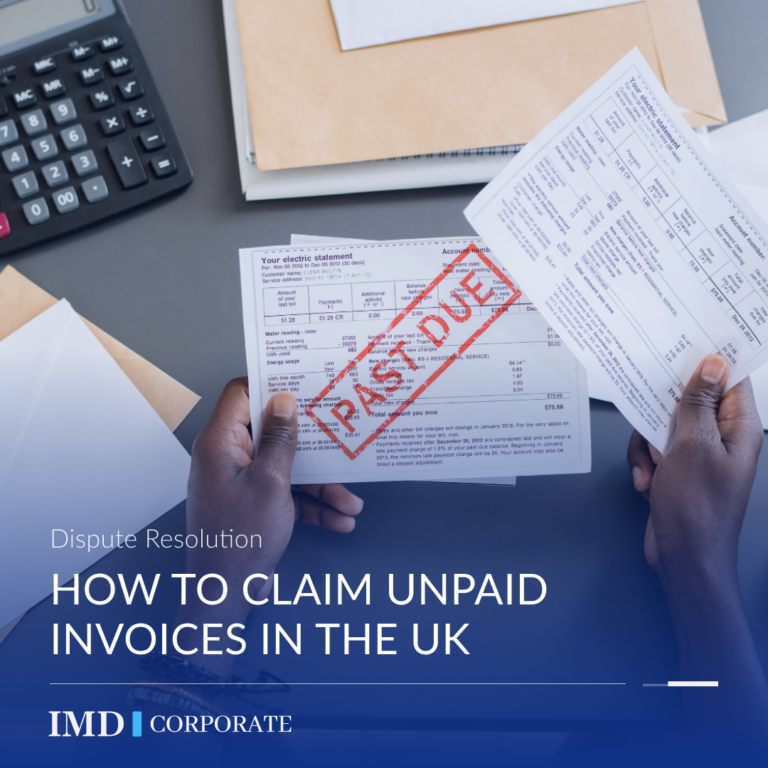 30 Mar 2026
 How to claim unpaid invoices in the UK
IMD Corporate obtained a substantial reduction of civil penalties imposed by UK Border Force on a transport operator, our client, and the vehicle driver. The penalties originally issued were significant; following detailed written representations, both penalties were materially reduced. This result reflects the practical value of early, evidence-based submissions under the Level of Penalty: Code of Practice (updated 1 December 2023) and the relevance of recent appellate authority addressing proportionality.
Read more 26 Mar 2026
 Is Alternative Dispute Resolution (ADR) legally binding?
Alternative Dispute Resolution (ADR) has become increasingly important in resolving commercial disputes in the UK. Businesses often prefer ADR because it can be faster, more flexible and less costly than court proceedings. A common question clients ask is: “Is ADR legally binding?” The answer depends on the type of ADR process used and the agreement […]
Read more 25 Mar 2026
 Clandestine Entrant Penalties for Transport Companies: What Has Changed in 2026?
Transport companies moving goods into the United Kingdom face significant financial risk if clandestine entrants are discovered in their vehicles. Under the UK civil penalty regime, operators and drivers may face substantial fines even where they had no intention of facilitating illegal entry.
Read more 16 Mar 2026
 Who has more control: a director or a shareholder?
Arbitration is widely recognised as a flexible, confidential and internationally enforceable method of dispute resolution. It is frequently used in commercial contracts, shareholder agreements, construction projects, joint ventures and cross-border transactions.
Read more